
Why is BJP implementing UCC in states instead of Parliament?

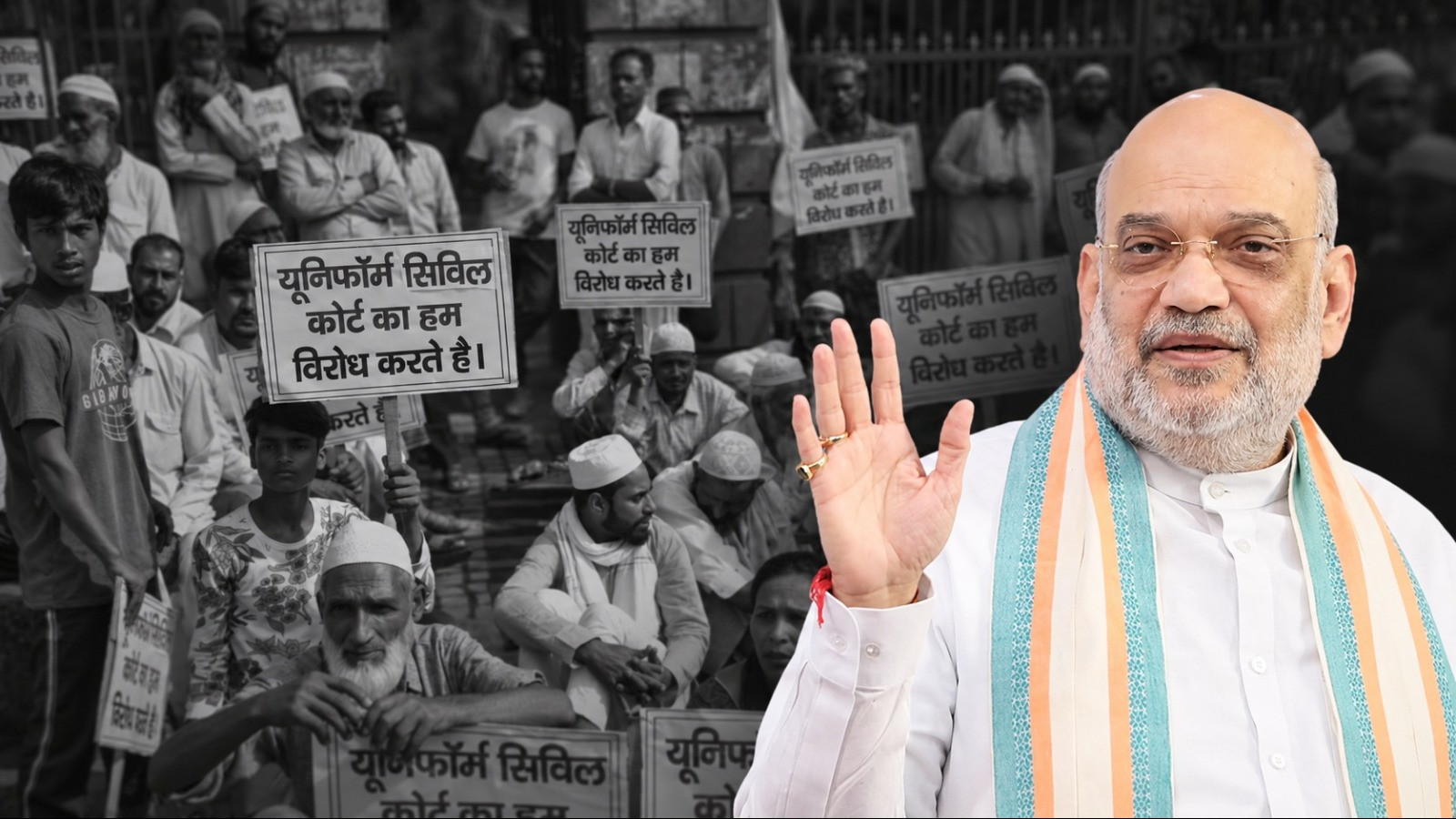
The concept of UCC is linked to the ideology of the RSS.
The ruling BJP government at the Centre has established a tradition over the past 11 years. It imposes laws or bills on the citizens of the country without any consultation, debate, or consensus. It is a completely unilateral decision and action. Sometimes, the agenda of the Sangh is even imposed on citizens through backdoor means. Upholding this tradition, Union Home Minister Amit Shah stated on September 13 that the Uniform Civil Code (UCC) will be implemented in all 21 states governed by the BJP-NDA before the 2029 Lok Sabha elections.
In Mumbai, Amit Shah said,
“We have implemented the Uniform Civil Code in several states, and I am confident that it will be implemented in all 21 states governed by the BJP-NDA before 2029.” He described the abolition of the practice of triple talaq as part of the government's efforts to provide equal rights to Muslim women.
It is noteworthy that after the construction of the Ram Temple in Ayodhya and the abrogation of Article 370, the UCC is a major unfinished goal of the BJP's old ideological agenda. After the UCC bill was passed in the Gujarat Assembly, Shah stated that implementing equal laws for every citizen has been the party's commitment since its inception.
It is important to note that the concept of UCC is linked to the ideology of the Rashtriya Swayamsevak Sangh (RSS). However, the RSS has maintained a relatively cautious stance regarding the methods and timing of its implementation. In 2023, when the Modi government made UCC a major political issue, sources linked to the RSS stated that there is a need for in-depth study and extensive discussion on this topic, as it affects every section of society.
The RSS wanted BJP-ruled states to implement the Uniform Civil Code at their own level first, and only then should the central government consider making it a nationwide law. In March 2024, RSS General Secretary Dattatreya Hosabale welcomed the Uttarakhand model and emphasized the need for study and extensive consultation to implement it across the country.
Amit Shah's 2029 deadline has now transformed this strategy of starting with states into a politically time-bound program. The big question now is why is the BJP implementing the UCC in states instead of making a national law? There are both constitutional and political reasons behind this. Matters related to marriage, divorce, adoption, inheritance, distribution of property without a will, succession, and joint family fall under entry number five of the Concurrent List of the Constitution. Therefore, both Parliament and state legislatures have the authority to make laws in these matters.
However, the political reason is more significant. When making a nationwide uniform law, the various personal laws and traditional practices existing in India must be taken into account. In the case of tribal communities and northeastern states, this challenge becomes even more complex.
In 2023, sources linked to the BJP and RSS expressed similar concerns. A BJP official stated that,
“The UCC cannot be codified in a general manner like criminal law, as the traditions of tribal communities in Uttarakhand or Himachal Pradesh are quite different from those of tribal communities in Chhattisgarh or the Northeast.”
By proceeding through the states, the BJP gets the opportunity to test different models, create provisions according to local customs, and implement it without facing the full political and constitutional complexities of a nationwide law. This keeps the issue of UCC politically active, and the party can present it as a measure for equal rights and social reform.
The UCC law has been passed in four BJP-ruled states—Uttarakhand, Gujarat, Assam, and Madhya Pradesh. However, it is currently effective only in Uttarakhand.
Uttarakhand implemented the UCC in January 2025. It established uniform rules for marriage, divorce, inheritance, and succession. It imposed a ban on polygamy and made marriage registration mandatory. A notable feature of Uttarakhand's UCC is the regulation of live-in relationships. Couples are required to register their live-in relationship and its termination. Children born from such relationships are granted the status of legitimate offspring.
The Gujarat Assembly passed the UCC bill in March 2026. It is largely based on the Uttarakhand model and includes marriage, divorce, inheritance, and live-in relationships. It also imposes a ban on bigamy.
Assam passed its UCC bill in May. It includes provisions related to marriage, divorce, inheritance, and live-in relationships. It bans polygamy and makes registration of live-in relationships mandatory.
The bill passed in Madhya Pradesh in July includes provisions related to the adoption process as well as triple talaq and nikah halala. Here too, registration of live-in relationships is mandatory, and polygamy is prohibited.
A significant similarity among these four laws is that Scheduled Tribes are excluded from their purview. Uttarakhand has also exempted some communities that have protection under constitutional provisions for traditional laws. Thus, while the laws of all four states are largely similar, they are not identical. None of these laws can be considered completely 'uniform' or 'universal' in the literal sense.
Opposition parties have raised questions about whether the BJP's UCC is truly a reform related to gender equality or an attempt to change the personal laws of minorities through a majoritarian framework.
The Congress party described the Gujarat UCC bill as “anti-Muslim,” while in Madhya Pradesh, it termed it the RSS's agenda. In Assam, opposition parties have also expressed concerns about the exemption given to tribals and the regulation of live-in relationships, demanding extensive consultation.
For the BJP's NDA allies, this issue is more complex.
The JD(U) has consistently stated that it does not oppose the UCC, but it should be implemented by consensus rather than being imposed. Nitish Kumar had told the Law Commission that,
UCC should respect the “fragile balance” that exists between various religious and ethnic communities in India.
Once again, the opposition and NDA allies have started opposing the UCC following Amit Shah's statement.
Senior Congress leader and former Union Minister Salman Khurshid said that,
The BJP has a certain ideology that we cannot agree with. Whatever steps they have taken in Uttarakhand or other states, or wherever they plan to implement them, they should first be examined under legal scrutiny. Whether the matter goes to the High Court or the Supreme Court, the decision will be based on fundamental rights—especially the right of every Indian citizen to practice their religion and faith. Only after the courts interpret these rights can anything be said for certain. Until then, they can keep speaking and doing whatever they want. If they think they can win elections just by making such statements without any solid work, then that is their choice.
Salman Khurshid further stated that,
I am aware that it has been challenged in Uttarakhand. The case filed there is still pending and awaiting hearing. I hope that a similar legal process will be adopted in other states as well.”
JDU leader Shyam Rajak spoke to ANI on Monday and said that,
When this bill came to Parliament, our leader (Nitish Kumar) clearly stated that I support the bill, but I will not allow it to be implemented in my state. We stand by that statement."
The Telugu Desam Party has also advocated for discussion and consensus on this issue. In 2024, the party stated that it would ensure the protection of the interests of the Muslim community.
Article 44 of the Constitution states that,
The state shall endeavor to secure for the citizens a uniform civil code throughout the territory of India. However, this provision is not part of fundamental rights, but is included in the directive principles of the state policy. Under Article 37, the directive principles are considered fundamental for governance, but they cannot be enforced through any court.
Meanwhile, AIMIM chief Asaduddin Owaisi opposed the UCC and said,
The BJP is not bringing a uniform civil code (UCC) for equality. It is only implementing the UCC in those states where it has a government, in order to target the 18 crore Muslims of India.
Owaisi stated that,
The step taken by the BJP and Amit Shah is against the religious freedom granted under Article 25, the right to equality provided under Article 14, and Articles 26 and 29. Therefore, we must first understand that the BJP is doing all this not for equality, but merely to target Muslims.
The main question of the debate is which matters should be brought to equality and how to balance it with religious freedom, traditional practices, and the constitutional protection afforded to tribal communities. There was also no consensus in the Constituent Assembly on what the form of the UCC should be. For this reason, it was placed in the directive principles.
The 21st Law Commission stated in its 2018 consultation paper regarding reforms in family laws that at that time, the UCC was “neither necessary nor desirable.”
The Commission advocated for changing discriminatory provisions in various personal laws while maintaining India's diversity. Its emphasis was on bringing equality between women and men within each community rather than establishing equality between communities. The Commission recommended phased reforms instead of imposing complete equality. It also identified the constitutional protection afforded to tribal and northeastern communities as a complex issue in implementing the UCC.
The 22nd Law Commission has revisited this issue in 2023 and sought new suggestions from the general public and recognized religious organizations. The Commission stated that more than three years have passed since the 2018 consultation, and in light of various developments, including court orders, a fresh review of the subject is necessary.