
Delhi HC grants bail to Mohammad Saqib after 8 years in jail

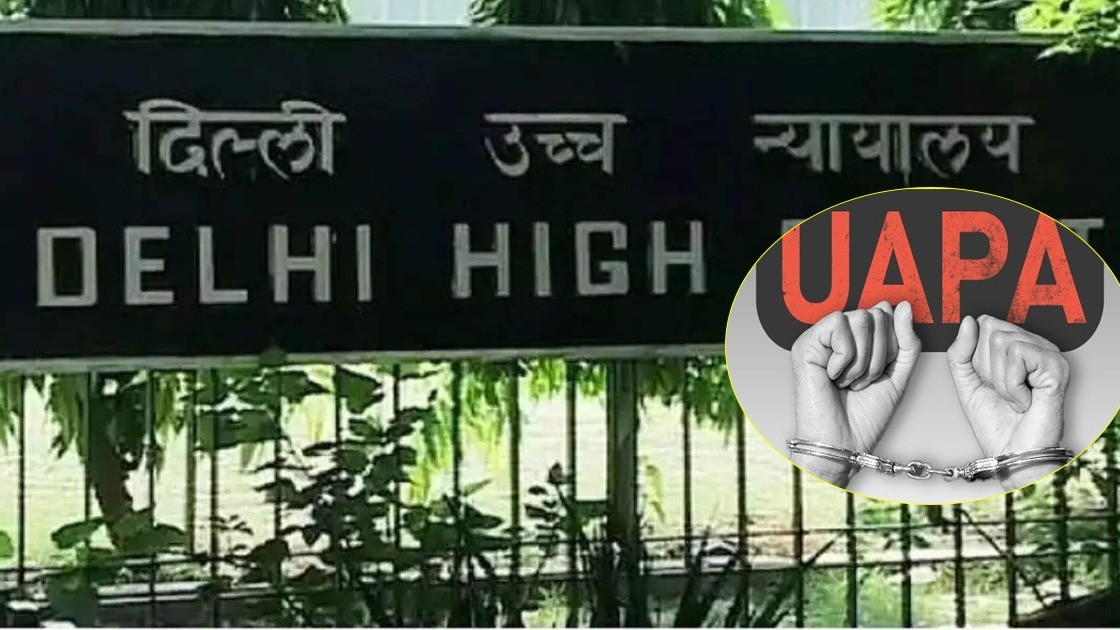
The Delhi High Court has granted bail to Mohammad Saqib, also known as Saqib Iftikhar, arrested for waging war against the Government of India.
The Delhi High Court granted bail on Monday to Mohammad Saqib alias Saqib Iftikhar, who was arrested on charges of waging war against the Government of India. The court noted that the accused has been imprisoned as an undertrial for nearly eight years, while the trial is unlikely to conclude soon.
According to a report by Bar and Bench, on September 14, a bench of Justice Navin Chawla and Justice Ravinder Dudey ordered the release of Saqib on bail. He was charged in 2018 under the Unlawful Activities (Prevention) Act, also known as UAPA, the Explosive Substances Act, and various sections of the Indian Penal Code. The court stated that out of a total of 120 witnesses for the prosecution, only 40 witness statements have been recorded so far. Therefore, the hearing of the trial does not appear to be concluding in the near future.
The National Investigation Agency (NIA) alleges that
Saqib was a member of an ISIS-backed group called ‘Harkat-ul-Harb-e-Islam’. According to the agency, he played a role in arranging meetings with Jaish-e-Mohammed terrorists for training and in gathering weapons with the intent to wage war against the government.
According to a report by Law Beat, this case is linked to an FIR registered in 2018. The FIR includes charges under sections 120B, 121, 121A, and 122 of the Indian Penal Code (IPC); sections 17, 18, 18B, 20, 38, and 39 of the Unlawful Activities (Prevention) Act UAPA; and sections 4 and 5 of the Explosive Substances Act.
According to the prosecution,
Saqib was accused of being a member of the ISIS-backed organization ‘Harkat-ul-Harb-e-Islam’. He was alleged to have propagated ISIS ideology and supported the ideology of Jaish-e-Mohammed. The investigating agency claimed that he had established contacts in the Tral area of Jammu and Kashmir to arrange local terrorists. He was also accused of playing a role in gathering weapons through his contacts in western Uttar Pradesh. Saqib had traveled to Jammu and Kashmir with co-accused Mohammad Absar in July 2017 and July 2018. The purpose of these trips was to establish contact with terrorists for training and weapons procurement. The NIA relied on witness statements, call detail records (CDR) analysis, electronic materials, and recoveries from Saqib's residence to support its allegations.
Saqib's lawyer argued that according to the allegations in the charge sheet, the appellant was not identified as part of the main module of the terrorist conspiracy. At most, he could be considered as someone playing a limited or peripheral role.
The lawyer stated that,
The only allegation against Saqib is that he traveled to Kashmir with accused number six, Mohammad Absar, in July 2017 and July 2018. There, he had requested prosecution witness number 27, Riyaz Ahmed Najar, to arrange a meeting with terrorists. It was acknowledged that witness Riyaz Ahmed Najar knew Saqib beforehand, as both had studied at the same madrasa in Uttar Pradesh. The defense argued that a complete reading of the witness's statement makes it clear that Saqib neither requested a meeting with terrorists nor showed any interest in such a meeting.
Opposing the bail, the NIA's special public prosecutor argued that considering the seriousness of the allegations and Saqib's alleged role in connecting members of the terrorist module, it is appropriate to keep him in custody.
Earlier, the additional sessions judge of the Patiala House Court had rejected Saqib's bail application. Following this, he approached the Delhi High Court for relief. Saqib argued in his petition that he was not involved in the main module of the terrorist conspiracy and at most his role was that of a limited or peripheral collaborator. Meanwhile, the NIA opposed the bail, stating that mere delay in the trial cannot be a basis for granting bail.
The High Court stated that,
At first glance, the witness statements are not serious enough to justify extending Saqib's custody. The court noted that while the materials recovered from his phone are serious, they are not sufficient to justify his continued detention at this time.
The bench set aside the lower court's order, stating, “Considering the witness statements, the allegations against the appellant, and particularly the long period of his incarceration, we believe he has made a case for being released on bail.”
The court also imposed several conditions on Saqib's bail. He will not be allowed to travel outside his hometown of Hapur, except to appear in court or report to the NIA office in Delhi. He must appear at the NIA's Lucknow office every fortnight.
Saqib has also been directed to deposit his passport with the lower court. Until the trial is completed, he will only be allowed to use one mobile phone or landline. He will not be able to change his mobile number or residence without informing the NIA and the lower court seven days in advance. The court also directed that Saqib will not share or disseminate any form of “anti-national material” through social media or any other medium.